
 Deutsch
 Français
 Español
 Italiano
 Nederlands
 Polski
 Português (Brasil)
 Türkçe
 Svenska
 Čeština
 Русский
 Українська
 日本語
 简体中文
 한국어
- Hexfolk
- Strategy
Strategy: how to win at Hexfolk
The most important decision in Hexfolk comes before the first roll: good starting spots sit on frequent numbers like 6, 8, 5 and 9 and cover as many different resources as possible. After that, the winner is usually whoever builds cities early, trades regularly and aims the robber at the player in the lead.
Setup decides a lot
Your two starting settlements feed you resources for the whole game. A weak start can be recovered from, but it costs you a lot of turns. Check every intersection against three questions: how often do the numbers of the adjacent hexes come up? Which resources will I get? Where can I expand from here?
- Add up the numbers: count the dots under the number tokens. An intersection on 6, 9 and 5 has 5 + 4 + 4 = 13 dots, one on 2, 3 and 11 only 1 + 2 + 2 = 5.
- Variety over volume: two hexes with the same number are risky. If that number doesn't come up for a while, you get nothing at all.
- Make the second settlement complement the first: because the second settlement pays out immediately, choose it so you can build a road on your first turn or a settlement soon after.
- Room to grow: leave yourself a direction in which a road leads to a third good spot before someone else takes it.
- Think about harbours: if you produce a lot of one resource, a matching 2:1 harbour within reach pays off.
In setup the starting player chooses first but places their second settlement last. The last player, in turn, places both settlements back to back and can match them up nicely.
Number probabilities
Two dice give 36 equally likely combinations. The number of dots on a token is exactly the number of combinations that produce its total.
| Total | Combinations out of 36 | Probability | On average every ... rolls |
|---|---|---|---|
| 2 | 1 | 2.8% | 36 |
| 3 | 2 | 5.6% | 18 |
| 4 | 3 | 8.3% | 12 |
| 5 | 4 | 11.1% | 9 |
| 6 | 5 | 13.9% | 7.2 |
| 7 | 6 | 16.7% | 6 |
| 8 | 5 | 13.9% | 7.2 |
| 9 | 4 | 11.1% | 9 |
| 10 | 3 | 8.3% | 12 |
| 11 | 2 | 5.6% | 18 |
| 12 | 1 | 2.8% | 36 |
With four players each person comes round roughly every four rolls. A hex on 6 therefore pays out about every other round, one on 2 on average only once in nine rounds. In the short term dice vary a lot. If you rely on a single number, expect long dry spells.
Weighing up resources
Not every resource is worth the same. It depends on the board, but some patterns repeat in almost every game.
- Lumber and brick pay for roads and settlements, so they matter most early on. Whoever has them spreads out quickly.
- Grain and ore lead to cities and development cards. A city doubles a settlement's production and adds a point without needing new space.
- Wool is often the easiest to come by, which makes it good trading material. You still need it for settlements and development cards.
- Scarcity counts: if the board has only one good ore hex, ore is the most valuable resource of the game. Plan your setup around it.
Two proven approaches: the expansion route relies on lumber and brick, builds lots of settlements and fights for the Longest Road. The city route relies on grain and ore, builds cities early and buys development cards for the Largest Army. Both work, as long as they suit your starting hexes.
Trading
Trading with other players is almost always cheaper than the bank. A 1:1 swap helps both sides, while the bank wants four cards for one.
- Offer what you have plenty of before a 7 forces you to discard.
- Don't trade with the leader when that exact card is what they need to win.
- A harbour reliably converts your surplus. A 2:1 harbour for a resource you get often is frequently worth more than another number hex.
- Keep your hand under 8 cards. Better to build a road now than lose half your hand on the next 7.
Using the robber
The robber is your tool against the player in the lead. Put it on a hex that brings the leader a lot, ideally a 6 or 8 next to one of their cities. If several players build on a hex, you hit all of them, so take care not to block yourself.
Steal from whoever probably holds what you're missing. Someone who has just received a lot of ore is a good target if you want to build a city. Knight cards from the deck give you a way to chase the robber off your own hex without waiting for a 7.
Development cards
Development cards cost wool, grain and ore and are best value when you produce those three anyway. 14 of the 25 cards are knights. Three knights played secure the Largest Army and 2 points, as long as nobody plays more.
Play knights in good time to get the robber off your hexes. Monopoly hits hardest when everyone else is holding a lot of one resource, for example after a run of rolls on the same number. Victory Point cards stay hidden, so other players can only guess your score.
Playing against bots
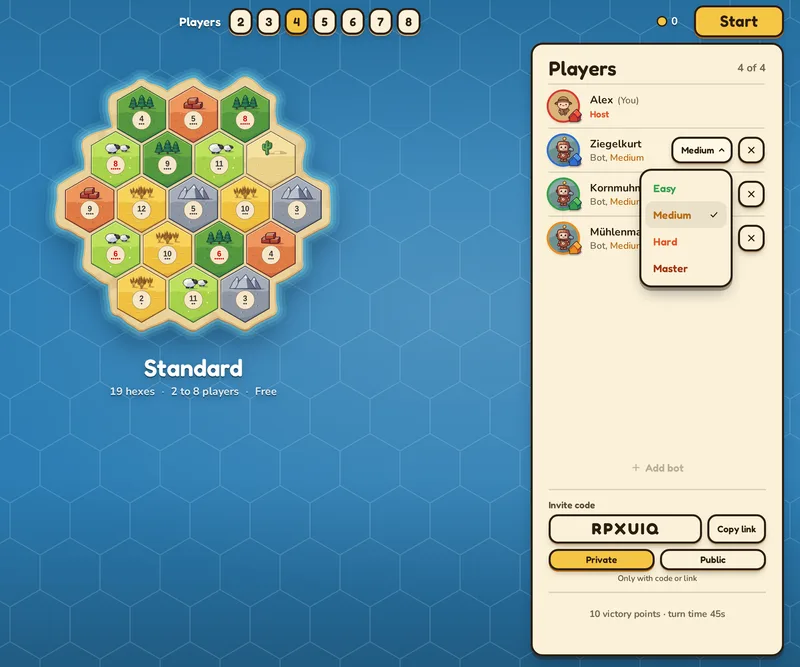
Hexfolk has four bot levels. They differ mainly in how well they choose their starting spots and how far ahead they plan.
| Level | Behaviour | How to beat it |
|---|---|---|
| Easy | picks its setup from the four best spots, never trades with the bank, places the robber at random | secure good starting spots and build cities quickly |
| Medium | picks from the two best spots, plans its second settlement in advance, uses bank trades | grab the Longest Road early and put the robber on its best hexes |
| Hard | always takes the best spot, plans its second settlement in advance and trades strategically with the bank | compete for the best intersections, use harbours, don't trade with the leader |
| Master | a planning bot that sets itself goals and recalculates after every step | spread your numbers, keep up pressure with the robber and have a clear plan from the start |
Bots are a good way to practise at your own pace: set the turn time to unlimited and the bot speed to slow, and you can follow every move they make. The Master also plays in Ranked when there aren't enough people in the queue.
Frequently asked questions
Which numbers are best?
6 and 8 come up most often after 7, at 13.9% each, followed by 5 and 9 at 11.1% each. A good starting intersection collects plenty of dots and spreads them across different numbers.
Should I build cities or settlements first?
That depends on your hexes. With lots of lumber and brick you spread out first, with lots of grain and ore you build cities early. A city doubles production without needing new space.
How do I beat the Master bot?
Secure a range of good numbers in setup, use harbours and aim the robber at its strongest hexes. It's worth playing a few games against Hard first to get the flow of the game into your fingers.